
Microibidion
|
publication ID |
https://doi.org/10.11646/zootaxa.4286.2.12 |
|
publication LSID |
lsid:zoobank.org:pub:6AE2A6F7-56EE-465C-9942-B9FD96CF6748 |
|
DOI |
https://doi.org/10.5281/zenodo.5167899 |
|
persistent identifier |
https://treatment.plazi.org/id/03F287C3-FF8E-731C-FF31-8E20FA6BF94A |
|
treatment provided by |
Plazi |
|
scientific name |
Microibidion |
| status |
|
Key to species of Microibidion View in CoL
1. Elytral apex with outer angle distinctly projected............................................................ 2
- Elytral apex with outer angle not projected................................................................ 3
2(1). Prothorax distinctly narrower basally than apically. Brazil ( Bahia, Minas Gerais, Espírito Santo, Rio de Janeiro, São Paulo, Paraná, Santa Catarina, Rio Grande do Sul) , Paraguay, Argentina (Misiones, Corrientes)........ M. exiguum Martins, 1962 View in CoL
- Basal and distal width of prothorax similar. Brazil ( Bahia, Rio de Janeiro)................. M. fluminense (Martins, 1962) View in CoL
3(1). Elytra with basal half reddish and distal half black, separated by transverse yellowish region. Argentina.......................................................................................... M. rubicundulum (Gounelle, 1913) View in CoL
- Elytra with different color pattern.........................................................................4
4(3). Elytra with 3 yellowish-white maculae. French Guiana................................. M. kawensis Audureau, 2015 View in CoL
- Elytra, at most, with 2 yellowish or whitish maculae..........................................................5
5(4). Prothorax uniformly rounded laterally, without distinct basal constriction. Brazil (Espírito Santo, Rio de Janeiro, Santa Catar- ina)........................................................................... M. muticum (Martins, 1962) View in CoL
- Prothorax with distinct basal constriction, subparallel-sided from constriction to distal margin........................ 6
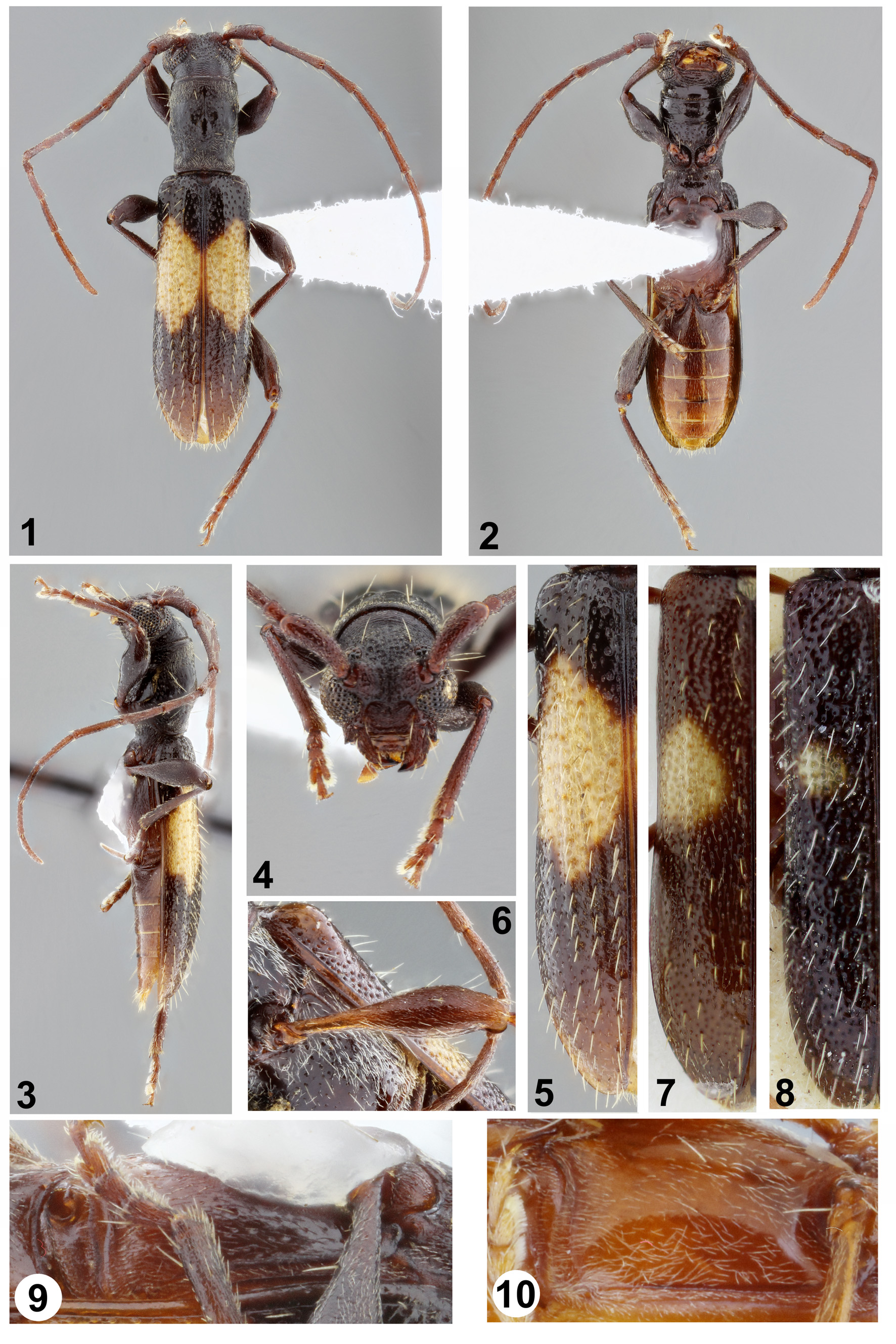
6(5). Antennomeres III–IV without long and erect setae along ventral side; elytra with erect setae distinctly sparse and short ( Fig. 7 View FIGURES 1 – 10. 1 – 5, 9 ). Paraguay................................................................. M. bimaculatum Mehl et al., 2015 View in CoL
- Antennomeres III–IV with long and erect setae along ventral side; elytra with erect setae long and moderately abundant ( Figs. 5, 8 View FIGURES 1 – 10. 1 – 5, 9 )............................................................................................... 7
7(6). Metasternum impunctate laterally ( Fig. 10 View FIGURES 1 – 10. 1 – 5, 9 ). Bolivia, Peru, Argentina ( Jujuy).................. M. mimicum Martins, 1971 View in CoL
- Metasternum punctate laterally ( Fig. 9 View FIGURES 1 – 10. 1 – 5, 9 )................................................................... 8
8(7). Antennae entirely reddish-brown; elytra with transverse and moderately narrow yellowish band at about midlength; mesofem- oral club slender ( Fig. 6 View FIGURES 1 – 10. 1 – 5, 9 ). Brazil ( São Paulo, Rio Grande do Sul) , Paraguay, Argentina (Misiones, Buenos Aires)......................................................................................... M. exculptum Martins, 1962 View in CoL
- Antennae dark brown, mainly on basal segments; elytra with large, irregular yellowish band covering about midlength of basal half and part of distal half; mesofemoral club thicker ( Figs. 1–3 View FIGURES 1 – 10. 1 – 5, 9 ). Bolivia.......................... M. morrisi View in CoL sp. nov.
No known copyright restrictions apply. See Agosti, D., Egloff, W., 2009. Taxonomic information exchange and copyright: the Plazi approach. BMC Research Notes 2009, 2:53 for further explanation.
|
Kingdom |
|
|
Phylum |
|
|
Class |
|
|
Order |
|
|
Family |