
Vitronura paraacuta, Wan, Ya-Ru, Wang, Wen-Bin & Jiang, Jigang, 2016
|
publication ID |
https://doi.org/10.11646/zootaxa.4139.2.3 |
|
publication LSID |
lsid:zoobank.org:pub:3A69D55D-884D-48D9-AF61-27AE7729D74D |
|
DOI |
https://doi.org/10.5281/zenodo.6056295 |
|
persistent identifier |
https://treatment.plazi.org/id/1D10480A-3B42-DC15-4EAD-392786DCDCBB |
|
treatment provided by |
Plazi |
|
scientific name |
Vitronura paraacuta |
| status |
sp. nov. |
Vitronura paraacuta sp. nov.
Figs 1–7 View FIGURE 1 View FIGURES 2 – 7 , Tab. 1–2 View TABLE 1 View TABLE 2 , 5 View TABLE 5
Type material. Holotype (female) and 7 paratypes ( 5 females and 2 males) on slides, China, Hunan Province, Changde City, Hefu forest park (29º03’021”N, 111º39’932”E), ca 50m a.s.l., under leaves at a small ditch in forest, 7.iv.2011, leg.: JiGang Jiang, Ya-Ru Wang and Wan-Jun Yu (collection number: J2012040701). All types deposited in Zoology Key Laboratory of Hunan Higher Education, Hunan University of Arts and Science, Changde, China.
Description. Body length: 1.7–2.6 mm ( holotype: 2.2 mm). Body color: red alive and white in alcohol.
Head: eyes 2+2 ( Fig. 1 View FIGURE 1 ). Antenna equal to diagonal of the head. Ant. I and II with 7 and 12 chaetae respectively. Ant. III dorsally fused to Ant. IV. Ant. III organ consists of 2 short microsensilla and 2 long sensilla (sgd and sgv); ventral ms present. Ant. IV with trilobed apical bulb, dorsally with 8 S, i -chaeta, 12 mou, 5 chaetae d and or ( Fig. 2 View FIGURES 2 – 7 ). Labrum distally not ogival, chaetotaxy as 0/2, 2( Fig. 6 View FIGURES 2 – 7 ). Labium with 2 x and 11 Chaetae ( Fig. 5 View FIGURES 2 – 7 ). Mandible with 4 teeth ( Fig. 3 View FIGURES 2 – 7 ). Maxilla crochet-like ( Fig. 4 View FIGURES 2 – 7 ). Cephalic tubercles and chaetotaxy see Fig. 1 View FIGURE 1 and Tab. 1 View TABLE 1 , dorsal macrochaetae and mesochaetae similar to those on thorax and abdomen; almost smooth with hyaline sheath and apically blunt. Microchaetae smooth and sharp. All dorsal cephalic tubercles (except L+So) independent. Tubercle Cl with 2 Mc and 2 me. Tubercle An with 1 Ml and 3 me. Tubercle Fr with 2 Ml and 1 Mc (O-chaeta). Tubercle Di on head with 1 Ml, and De with 1 Ml and 2 me. Tubercle Dl with 1 Ml and 3 me. Tubercle L+So with 3 Ml and 5 me.
Thoracic and abdominal tubercles and chaetotaxy shown in Figs. 1 View FIGURE 1 , 7 View FIGURES 2 – 7 and Tab. 2 View TABLE 2 . Chaetae formula of tubercle Di on Th. I–Abd. V as 1, 3, 3/2, 2, 2, 2, 3. Sensory chaetae and s-microchaeta formula on Th. I–Abd. V as 0, 2+ms, 2/1, 1, 1, 1, 1. Di tubercle on Abd. V with 1 Ml, 2 me ( Fig. 1 View FIGURE 1 ). Each tubercle on Abd. VI with 7 chaetae (4 Ml and 3 me).
Appendages: Ventral tube with 4+4 chaetae ( Fig. 7 View FIGURES 2 – 7 ). Furcal vestige with 5 (sometimes 4) chaetae ( Fig. 7 View FIGURES 2 – 7 ). Unguis with an inner tooth and without lateral tooth. Chaetotaxy of legs, ventral tube and furcal rest shown in Tab. 2 View TABLE 2 .
Etymology. The name of the new species derived from its similarity of chaetotaxy to North Korean species V. acuta Deharveng & Weiner, 1984 .
Terga Legs Remarks. This new species is most similar to V. a c ut a Deharveng & Weiner, 1984, but it differs by the bigger size (1.7–2.6 mm vs. 1.2 mm); trilobed apical bulb of Ant. IV ( vs. simple or bilobated in the latter); mandible with 4 teeth ( vs. 3 teeth in the latter); claw with inner tooth ( vs. claw without inner tooth in the latter), group Ve on Abd. IV with 7–8 chaetae ( vs. 10 chaetae to the latter). Diagnostic characters between the new species and some similar species of the genus are presented in Tab. 5 View TABLE 5 .
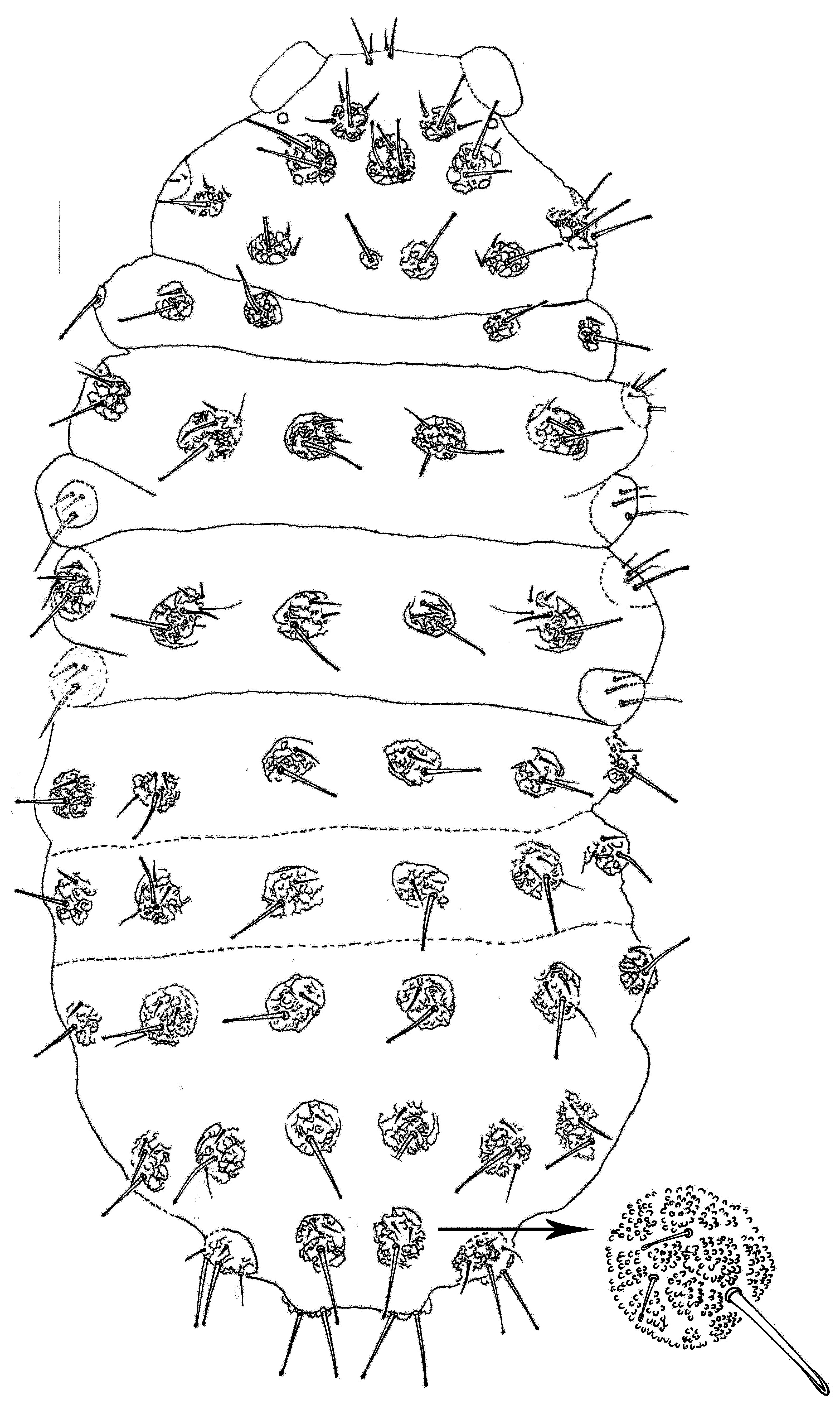
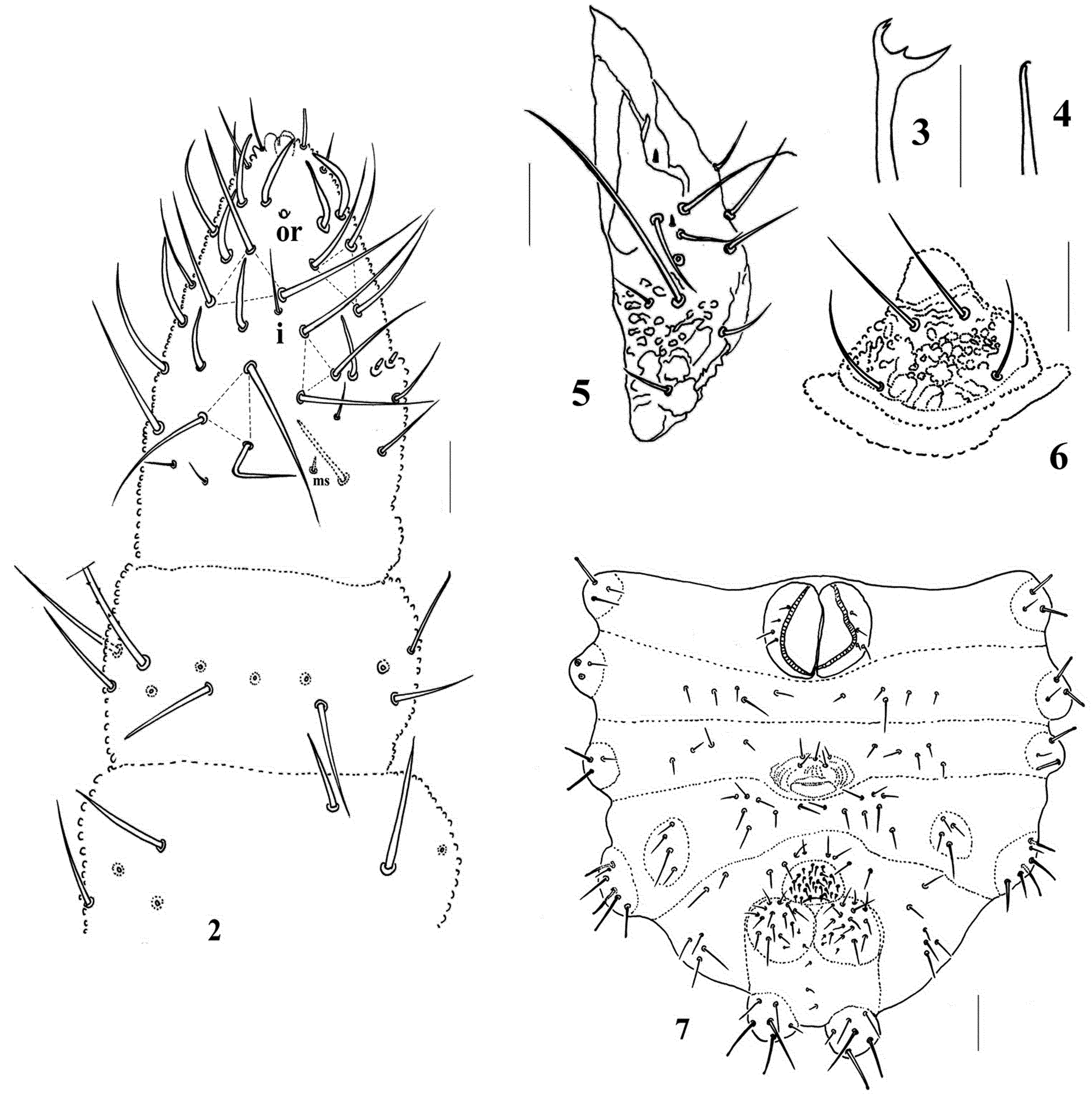
TABLE 1. Cephalic tubercles and chaetotaxy of Vitronura paraacuta sp. nov.
| Tubercle | Number and type of chaetae | Names of chaetae |
|---|---|---|
| Cl | 2 Mc 2 me | F G |
| An | 1 Ml 3 me | B C, D, E |
| Fr | 2 Ml 1 Mc | A O |
| Oc | 1 Ml 1 Mc 1 me | Ocm Ocp Oca |
| Di | 1 Ml | Di1 |
| De | 1 Ml 2 me | De1 De2, Di2 |
| Dl | 4 (1 Ml + 3 me) | uncertain |
| L+So | 8 (3 Ml + 5 me) | uncertain |
No known copyright restrictions apply. See Agosti, D., Egloff, W., 2009. Taxonomic information exchange and copyright: the Plazi approach. BMC Research Notes 2009, 2:53 for further explanation.
|
Kingdom |
|
|
Phylum |
|
|
Class |
|
|
Order |
|
|
Family |
|
|
SubFamily |
Neanurinae |
|
Tribe |
Paleonurini |
|
Genus |