
Acrogonia youngi, Silva, Roberta Dos Santos Da, Cavichioli, Rodney R., Takiya, Daniela M. & Mejdalani, Gabriel, 2017
|
publication ID |
https://doi.org/10.11646/zootaxa.4244.4.4 |
|
publication LSID |
lsid:zoobank.org:pub:D3D6480B-9EC4-4BA2-804B-735E1ED163D5 |
|
DOI |
https://doi.org/10.5281/zenodo.6016092 |
|
persistent identifier |
https://treatment.plazi.org/id/CCBCC654-5835-4BB5-AF8D-889EEC0BB843 |
|
taxon LSID |
lsid:zoobank.org:act:CCBCC654-5835-4BB5-AF8D-889EEC0BB843 |
|
treatment provided by |
Plazi |
|
scientific name |
Acrogonia youngi |
| status |
sp. nov. |
Acrogonia youngi View in CoL sp. nov.
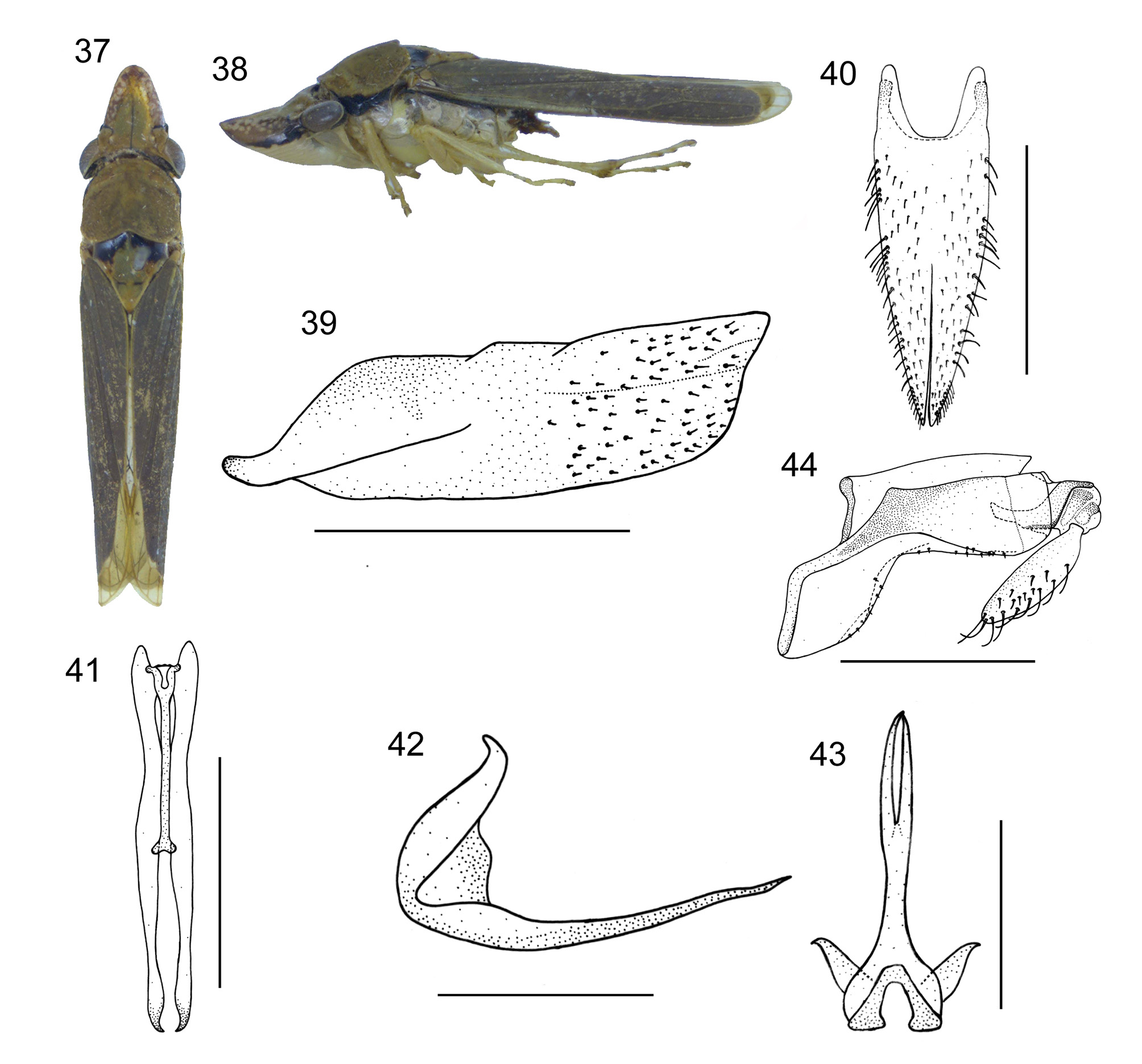
( Figs. 37–44 View FIGURES 37 – 44 )
Total length. Male holotype 11.5 mm; male paratypes 11.0–12.0 mm (n = 7); female unknown.
Holotype description. Head and thorax. Structural features of head and thorax ( Figs. 37–38 View FIGURES 37 – 44 ) much as described above for A. amazonensis sp. nov., except for median length of crown slightly longer than interocular width and approximately 8/10 transocular width.
Color. Anterior dorsum ( Fig. 37 View FIGURES 37 – 44 ) brownish-green; anterior and lateral portions of crown up to frontogenal sutures brown with irregular yellow marks; antennal ledges, frontogenal, temporal, and coronal sutures dark brown to black; pronotum with narrow dark brown to black marks anteriorly and laterally; mesonotum with large dark brown to black area anteriorly, its apex pale yellow. Forewings ( Figs. 37–38 View FIGURES 37 – 44 ) brownish-green, except for membranous portions. Face ( Fig. 38 View FIGURES 37 – 44 ) yellow with narrow dark brown to black area on superior portion. Lateral and ventral portions of thorax and legs ( Fig. 38 View FIGURES 37 – 44 ) mostly yellow; lateral lobe of pronotum narrowly dark brown to black on superior portion.
Male genitalia. Pygofer ( Fig. 39 View FIGURES 37 – 44 ), in lateral view, strongly produced posteriorly; without ventral lobe; surface with scattered setae, which are more visible on distal half of disc. Subgenital plates ( Fig. 40 View FIGURES 37 – 44 ), in ventral view, triangular, basal third slightly expanded laterally and then tapering gradually toward apex; in lateral view, plates elongate, extending almost as far posteriorly as pygofer apex; plate surface with scattered setae. Connective ( Fig. 41 View FIGURES 37 – 44 ), in dorsal view, Y-shaped; arms very short; stalk very long, without median keel, apex slightly expanded. Style ( Fig. 41 View FIGURES 37 – 44 ), in dorsal view, extremely elongate, extending posteriorly much farther than apex of connective; without preapical lobe; apical portion directed ventrally; apex acute. Aedeagus ( Figs. 42–43 View FIGURES 37 – 44 ) symmetrical, slender, slightly curved dorsally, bifid distally; without processes. Anal tube ( Fig. 44 View FIGURES 37 – 44 ) without processes.
Female unknown.
Etymology. The new species name is given in honor of the late Dr. David Allan Young (North Carolina State University, Raleigh) in recognition of his remarkable contribution to our knowledge of the world Cicadellidae , including the genus Acrogonia .
Type material. Holotype: male, “ PERU \ [department of] Madre de Dios \ sw Pto Maldonato \ 290m \ BM 1989-70” ( NHM) . Paratypes: one male, same data as holotype ( DZUP) ; one male, “CRUZEIRO DO SUL\ Acre— Brasil—II-63\ M. [Moacir] Alvarenga ” ( MNRJ) ; five males, “ Rio Branco—AC\ 12-Jan-2004 \ Albuquerque, E. S. ” ( DZRJ, DZUP, MNRJ) .
No known copyright restrictions apply. See Agosti, D., Egloff, W., 2009. Taxonomic information exchange and copyright: the Plazi approach. BMC Research Notes 2009, 2:53 for further explanation.
|
Kingdom |
|
|
Phylum |
|
|
Class |
|
|
Order |
|
|
Family |
|
|
SubFamily |
Cicadellinae |
|
Tribe |
Proconiini |
|
Genus |