
Moenkhausia chlorophthalma, Sousa & Netto-Ferreira & Birindelli, 2010
|
publication ID |
https://doi.org/10.1590/S1679-62252010000200003 |
|
DOI |
https://doi.org/10.5281/zenodo.17806049 |
|
persistent identifier |
https://treatment.plazi.org/id/3D6387B3-FFAE-FFC4-3E72-5779428CFB71 |
|
treatment provided by |
Carolina |
|
scientific name |
Moenkhausia chlorophthalma |
| status |
sp. nov. |
Moenkhausia chlorophthalma View in CoL , new species
Figs. 1-3 View Fig View Fig View Fig
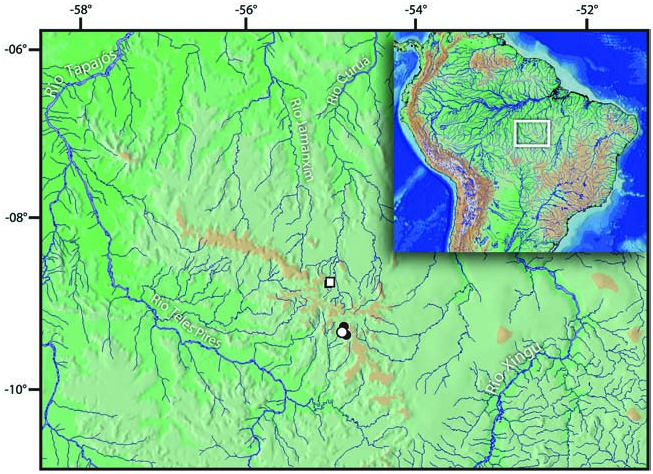
Holotype. MZUSP 99412 View Materials ( 67.4 mm SL), Brazil, Pará, Altamira, rio Treze de Maio , tributary of rio Curuá , rio Iriri basin , rio Xingu drainage , 08º45’06”S 55º02’05”W, 23 Jan 2009, A. L. Netto-Ferreira, J. L. Birindelli, L. M. Sousa & P. Hollanda-Carvalho. GoogleMaps
Paratypes. ANSP 188909 About ANSP (5, 32.9-50.3 mm SL) , AUM 50663 (5, 37.6-43.6 mm SL) , INPA 33764 View Materials (5, 34.7-49.4 mm SL) , MCP 44509 (5, 41.0-48.0 mm SL) , MNRJ 35382 View Materials (5, 33.8-48.5 mm SL) , MPEG 18327 View Materials (5, 37.9-52.9 mm SL) and MZUSP 101426 View Materials (81, 23.7-67.9 mm SL), same data as holotype GoogleMaps . MZUSP 97092 View Materials ( 28, 38.0- 64.8 mm SL, 2 c&s, 43.3-49.6 mm SL), Brazil, Pará, Altamira, rio Treze de Maio , tributary of rio Curuá , rio Iriri basin , rio Xingu drainage , 08º45’06”S 55º02’05”W, 22 Nov 2007, J. L. Birindelli, L. M. Sousa, A. L. Netto-Ferreira, M. H. Sabaj Pérez & N. K. Lujan GoogleMaps .
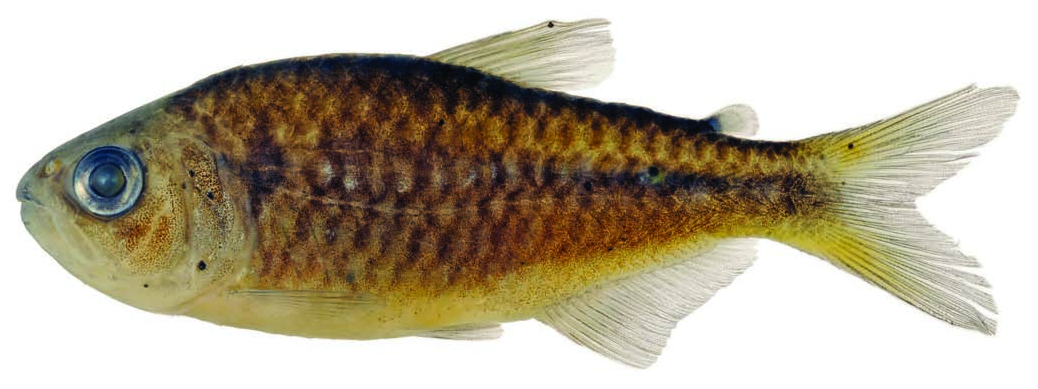
Diagnosis. Moenkhausia chlorophthalma is distinguished from all congeners, except M. petymbuaba and M. plumbea by the presence of large dark blotches on the anterior to central portions of the scales forming the seven dorsalmost longitudinal series ( vs. pigmentation absent or, when present, concentrated posteriorly along the border of the scales, and forming a reticulate pattern on the body). Moenkhausia chlorophthalma can be differentiated from both M. petymbuaba and M. plumbea by the possession of a proximal well-delimited black area on the adipose fin ( vs. adipose fin with uniformly scattered dark chromatophores), 7 longitudinal rows of large dark blotches ( vs. 8-9), 25-28 lateral line scales ( vs. 33-36), 4 scales between the lateral line and the dorsal-fin origin ( vs. 5), and 7-12 scales covering the anal-fin base ( vs. 4-9). Moenkhausia chlorophthalma can be further separated from M. petymbuaba by lacking a conspicuous midlateral dark stripe ( vs. presence of conspicuous midlateral dark stripe); and from M. plumbea by having 7 branched pelvic-fin rays ( vs. 6-7 in specimens of M. plumbea examined).
Description. Morphometric data presented in Table 1 View Table 1 . Overall size small (largest examined specimen 67.4 mm SL). Body compressed, moderately elongate. Greatest body depth located slightly anterior to dorsal-fin origin. Dorsal profile of head slightly convex from upper lip to vertical through nares; mostly straight from latter point to tip of supraoccipital spine; convex from tip of supraoccipital spine to dorsal-fin origin, straight from near of dorsal fin base to adipose fin; slightly concave between latter and origin of anteriormost dorsal procurrent caudal-fin ray. Ventral profile of head and body distinctly convex from lower lip to anal-fin origin; straight along anal-fin base, and concave between terminus of analfin and anteriormost procurrent caudal-fin ray.
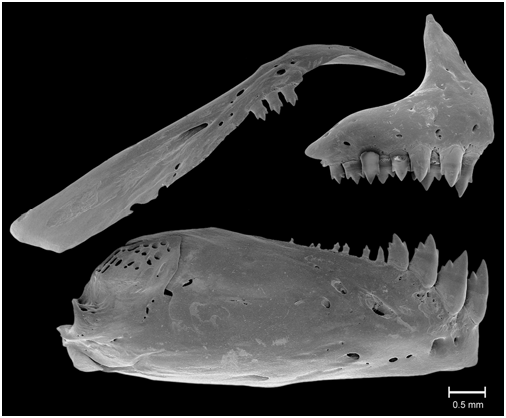
Mouth terminal. Posterior limit of maxilla almost reaching vertical through middle of orbit. Premaxillary teeth in two rows ( Fig. 3 View Fig ). Outer row with four (1) or six (1), relatively compressed, tricuspid teeth. Inner row with five (2) bulky tri- to pentacuspid teeth. Symphyseal tooth largest, asymmetrical, with single lateral cusp on anteromedial margin. Maxilla with three equal-sized tricuspid teeth. Dentary with four anteriormost teeth large, robust, pentacuspid, followed by a series of distinctly smaller, conic or tricuspid teeth. First gill arch with 1(2) hypobranchial, 8(2) ceratobranchial, 1(2) on cartilage between ceratobranchial and epibranchial, and 5(1) or 6(1) epibranchial gill-rakers. Branchiostegal rays 4(2), three originating on anterior ceratohyal and one on posterior ceratohyal.
Scales cycloid, with circuli absent on exposed area of scales, and few slightly divergent radii (usually less than 10) extending to posterior margin of scales. Lateral line slightly curved ventrally, completely pored, with 25(7), 26(10), 27*(20) or 28(8) perforated scales. Horizontal scale rows between dorsal-fin origin and lateral line 4(45). Horizontal scale rows between lateral line and pelvic-fin insertion 4(45). Predorsal scales 7(16), 8*(10) or 9(4). Single row of 7(1), 8(1), 9*(5), 10(12), 11(10) or 12(1) scales covering base of anteriormost anal-fin rays. Fourteen circumpeduncular scales. Caudal-fin scaled on proximal one-fifth of upper and lower caudal-fin lobes.
Pectoral-fin rays i, 10(15) or 11*(15). Tip of pectoral fin reaching vertical through pelvic-fin origin. Pelvic-fin rays i, 7. Supraneurals 5(2). Dorsal-fin rays ii, 9(46). Dorsal-fin origin situated slightly posterior to middle of standard length. Base of posteriormost dorsal-fin ray located at vertical through anal-fin origin. First dorsal-fin pterygiophore inserted posteriorly to neural spine of 10 th vertebra (2). Adipose fin present.Anal-fin rays iii, 19(1); iii, 20(1); iv, 18(2); iv, 19*(12); iv, 20(19); iv, 21(3); iv, 22(1); v, 19(1); v, 20(2) or v, 21(1). Anteriormost anal-fin pterygiophore inserted behind haemal spine of 17 th (2) vertebra. Caudal-fin forked, lobes slightly rounded, similar in size. Principal caudal-fin rays i,9+8,i. Dorsal procurrent caudal-fin rays 13(2) and ventral procurrent caudal-fin rays 9(1) or 11(1). Total vertebrae 34(1) or 35(1), with 16(1) or 17(1) precaudal and 18(2) caudal vertebrae.
Color in alcohol. Ground color tan, with chromatophores densely covering entire body, except for ventral portion. Lower lip, snout, top of head and dorsal portion of body darkly pigmented, resulting in overall countershaded color pattern. Edge of upper lip dark. Inconspicuous humeral blotch present, vertically elongated. Seven dorsalmost longitudinal scale rows with scales bearing large dark blotches anterior to center of each, with blotch fading towards scale border. Longitudinal, broad, dark midlateral stripe slightly curved ventrally, extending from pectoral girdle to tip of middle caudal-fin rays. Stripe diffuse, formed by scattered chromatophores. Dorsal, caudal, anal, and pectoral fins hyaline, with small scattered chromatophores. Adipose fin with proximally well-delimited dark area ( Fig. 1 View Fig ).
Color in life. Ground color of dorsal portion of body yellow to greenish, with iridescent midlateral yellow stripe and large, dark, ventrally curved longitudinal stripe immediately ventral to it, stripe extending from humeral region to caudal peduncle. Abdominal region white to light yellow. Eye bright green. Middle caudal-fin rays with dark mark, anteriorly delimited by dorsal and ventral yellowish areas ( Fig. 2 View Fig ).
Etymology. From the Greek chloros, meaning green, and ophthalmos, meaning eye, in reference to the iridescent green eyes in live specimens. An adjective.
Distribution. Known from type-locality ( Figs. 4 View Fig and 5 View Fig ).


No known copyright restrictions apply. See Agosti, D., Egloff, W., 2009. Taxonomic information exchange and copyright: the Plazi approach. BMC Research Notes 2009, 2:53 for further explanation.
|
Kingdom |
|
|
Phylum |
|
|
Class |
|
|
Order |
|
|
Family |
|
|
Genus |