
Globoppia vernoncrookensis, Hugo-Coetzee, 2017
|
publication ID |
https://doi.org/10.11646/zootaxa.4311.2.3 |
|
publication LSID |
lsid:zoobank.org:pub:9CD03C02-91B7-40CA-8B84-5D3836BD7913 |
|
DOI |
https://doi.org/10.5281/zenodo.6023779 |
|
persistent identifier |
https://treatment.plazi.org/id/4B2C87CB-C54F-FFA1-FF02-8AE2DF07F897 |
|
treatment provided by |
Plazi |
|
scientific name |
Globoppia vernoncrookensis |
| status |
sp. nov. |
Globoppia vernoncrookensis View in CoL sp. nov.
( Figs 2 View FIGURE 2 , 3 View FIGURE 3 )
Diagnosis. Adult: body size: 324–409 × 219–268; translamellar line present; interlamellar seta present, short; bothridial seta with long curved stalk and clavate head; notogastral seta c 2 present, setae la, lm much longer than other setae and almost in a transverse line; all dorsal and ventral setae smooth, except rostral seta weakly barbed.
Description. Measurements. Length: females (n = 9) mean 373 (range 324–409), male (n = 1) 373. width: females 245 (219–268), male 244. Holotype (female): length 385, width 250.
Integument ( Fig. 2 View FIGURE 2 A, C). Body surface smooth; exobothridial region to pedotectum I tuberculate.
Prodorsum ( Fig. 2 View FIGURE 2 A, C). Rostrum rounded; rostral seta ( ro, 54–66) located dorso-laterally, weakly barbed, lamellar seta ( le, 41–58) thin, smooth, interlamellar seta ( in, 6–10) very short and thin (not visible in lateral view, obscured by bothridial seta), lamellar seta closer to rostral than to interlamellar seta, exobothridial seta ( ex) could not be discerned; weak translamellar line present, weak lamellar lines extending from translamellar line to halfway between lamellar seta and bothridium, lamellar seta inserted posterior to translamellar line; two pairs of muscle sigillae in interlamellar region; bothridial seta ( bs, 63–75) clavate, smooth, stalk long with an s-like curve; tubercle present on hysterosoma in dorsosejugal region, varying in distinctness (seen in lateral view); pedotectum I typical for genus.
Notogaster ( Fig. 2 View FIGURE 2 A–C). Ten pairs of smooth notogastral setae, la, lm (47–59)> lp (25–33)> c 2 (13–20)> h 1–3, p 1–3 (7–15), setae la, lm thick, h 1, p 1–3 very thin (difficult to observe); p 1 better observed in ventral view, p 2, p 3 distanced from p 1, setae lm, la almost on a transverse line, setae lp, h 3 on a transverse line; distance between h 1- h 1 shorter than between p 1- p 1, h 3 posterior to lyrifissure im; lyrifissures ia, im distinct (7–15), other lyrifissures not visible.
Gnathosoma and epimeral region ( Fig. 2 View FIGURE 2 B–C). All setae thin, smooth; subcapitular setae a, m, h of similar length (19–29); epimeral setae 3b, 3c, 4a, 4c (30–45)> 1b, 1c (26–35)> 1a, 2a, 3a, 4b (14–24); 3b often directed horizontally; discidium ( dis) rounded distally.
Anogenital region ( Fig. 2 View FIGURE 2 B). All setae thin, smooth; six pairs of genital ( g 1, g 6: 12–18> g 2–5: 7–14), one pair of aggenital ( ag, 16–25), two pairs of anal ( an, 12–16) and three pairs of adanal ( ad) setae present; ad 1 (12–18) slightly shorter than ad 2, ad 3 (15–24), ad2 posterior to lyrifissure iad (9–13).
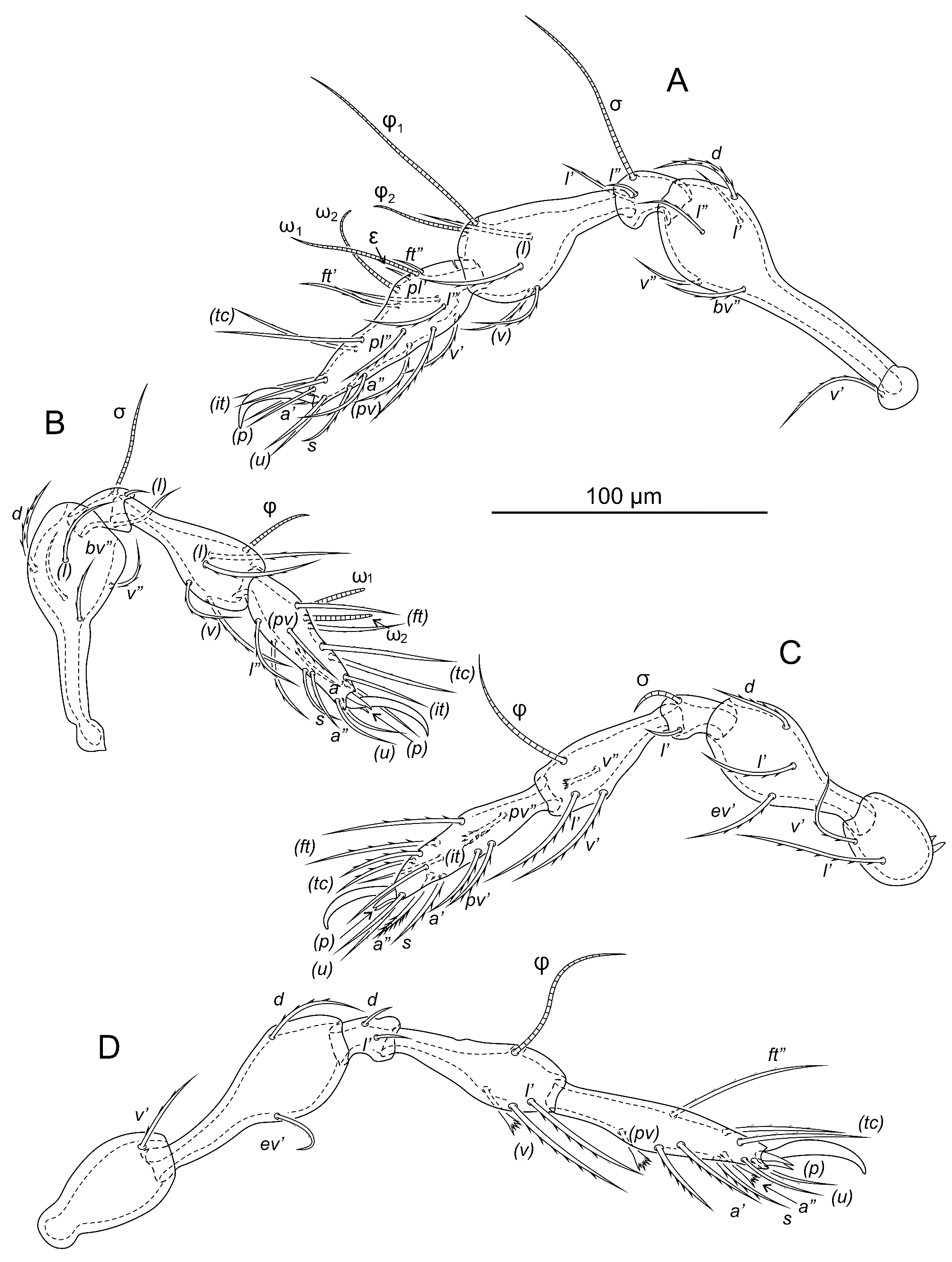
Legs ( Fig. 3 View FIGURE 3 A–D). Leg IV (276–309)> leg I (237–297)> leg III (215–237)> leg II (189–236); leg setation (see Table 1 for details): leg I: 1–5–2(1)–4(2)–20(2), leg II: 1–5–2(1)–4(1)–16(2), leg III: 2–3–1(1)–3(1)–15, leg IV: 1– 2–2–3(1)–12; all setae barbed, except smooth setae l” on Ge I, II, l’ on Ge III, IV, ( p), ( u), ( it) on Ta I, ( u) on Ta II and d on Ge IV; setae ( p) on Ta II–IV smooth, tooth-like; setae v” on Ti IV, pv”, a” on Ta IV penicillate.
Roman letters refer to normal setae, Greek letters refer to solenidia (except ε to famulus), parentheses indicate pairs of setae. Setae on the anterior side of a leg segment are indicated with a single accent ( ’) and setae on the posterior side with a double accent ( ”).
Etymology. The species name ‘ vernoncrookensis ’ is derived from the type locality, Vernon Crookes Nature Reserve.
Type material. The holotype and 10 paratypes were collected in Vernon Crookes Nature Reserve, KwaZulu- Natal (3017.057’S, 3035.290’E) by D.J. Kok, 25.III.1986 from rich organic soil. The holotype ( NMB 3478.16.1) and seven paratypes ( NMB 3478.16.2) are deposited in the Acarology collection of the National Museum, Bloemfontein, South Africa . Three paratypes ( SMNG, DNR 56549) are stored in Senckenberg Museum für Naturkunde, Görlitz, Germany .
Remarks. Globoppia vernoncrookensis sp. nov. is most similar to Globoppia hamiltoni ( Mahunka, 1988) from Tanzania in the presence of weak translamellar and lamellar lines, short interlamellar setae, position and length of all notogastral setae and presence of a weak tubercle on the hysterosoma in the dorsosejugal region. These two species differ from each other in size ( G. vernoncrookensis sp. nov. 324–409 × 219–268; G. hamiltoni 442–480 × 303–320), lamellar setae ( G. vernoncrookensis sp. nov. smooth; G. hamiltoni barbed), stalk of the bothridial seta ( G. vernoncrookensis sp. nov. long, curved; G. hamiltoni short), length of aggenital relative to adanal setae ( G. vernoncrookensis sp. nov. similar in length; G. hamiltoni more than double in length), position of adanal seta ad 2 relative to lyrifissure iad ( G. vernoncrookensis sp. nov. far posterior; G. hamiltoni lateral to slightly postero-lateral).
The new species is similar to the other South African species in the presence of seta c 2 and very weak translamellar lines, as well as seta ad 2 positioned posterior to iad. However, the new species differs from them in its smaller size ( G. vernoncrookensis sp. nov. 324–409 × 219–268; G. curviclavata 451–477 × 270–287; G. gibba 508– 566 × 320–369; G. globifera 393–435 × 236–260), short interlamellar seta (long in G. globifera ), presence of tubercle in the dorsosejugal region (absent in G. curviclavata ), smooth notogastral setae (ciliate in G. curviclavata , G. globifera ); relative position of notogastral setae lm and la ( G. vernoncrookensis sp. nov., G. curviclavata , G. globifera almost on a transverse line; G. gibba posterior).

No known copyright restrictions apply. See Agosti, D., Egloff, W., 2009. Taxonomic information exchange and copyright: the Plazi approach. BMC Research Notes 2009, 2:53 for further explanation.
|
Kingdom |
|
|
Phylum |
|
|
Class |
|
|
Order |
|
|
SubOrder |
Oribatida |
|
Family |
|
|
SubFamily |
Lanceoppiinae |
|
Genus |