
Acalypha isaloensis I.Montero & Cardiel
|
publication ID |
https://doi.org/10.5252/adansonia2023v45a26 |
|
DOI |
https://doi.org/10.5281/zenodo.10667970 |
|
persistent identifier |
https://treatment.plazi.org/id/C00D879E-FF95-5310-20BA-FB2F8E17F9CF |
|
treatment provided by |
Plazi |
|
scientific name |
Acalypha isaloensis I.Montero & Cardiel |
| status |
|
23. Acalypha isaloensis I.Montero & Cardiel View in CoL
Systematic Botany 45 (1): 122 ( Montero Muñoz et al. 2020a). —
Type: Madagascar. Ihorombe ( Fianarantsoa prov.), Massif de l’Isalo, à l’est de Ranohira, Andohakandrareza, au SE de la Piscine , 810 m, 22°33’S, 45°21’E, 14.II.1990, J.N.Labat 2119 ( holo-, P [ P00513133 ] GoogleMaps ; iso-, ILLS, K) GoogleMaps .— Paratypes: Madagascar. Ihorombe ( Fianarantsoa prov.), Isalo, canyon des Singes , 746 m, 22°29’12.239”S, 45°22’43.381”E, 15.IV.1967, H. Jacquemin H278J ( P [ P04804757 , P04804758 ]) GoogleMaps ; Isalo, canyon des Rats, pied des falaises le long du ruisseau , 899 m, 22°28’47.759”S, 45°22’39.601”E, III.1960, M.Keraudren-Aymonin 402 ( P [ P04804755 ]) GoogleMaps ; Ranohira, Isalo-Gebirge , 900 m, 22°33’20.307”S, 45°25’09.167”E, 22.XII.1959, H.-J.Schlieben 8236 ( B, BR [ BR0000021450358 ], G, K) GoogleMaps .
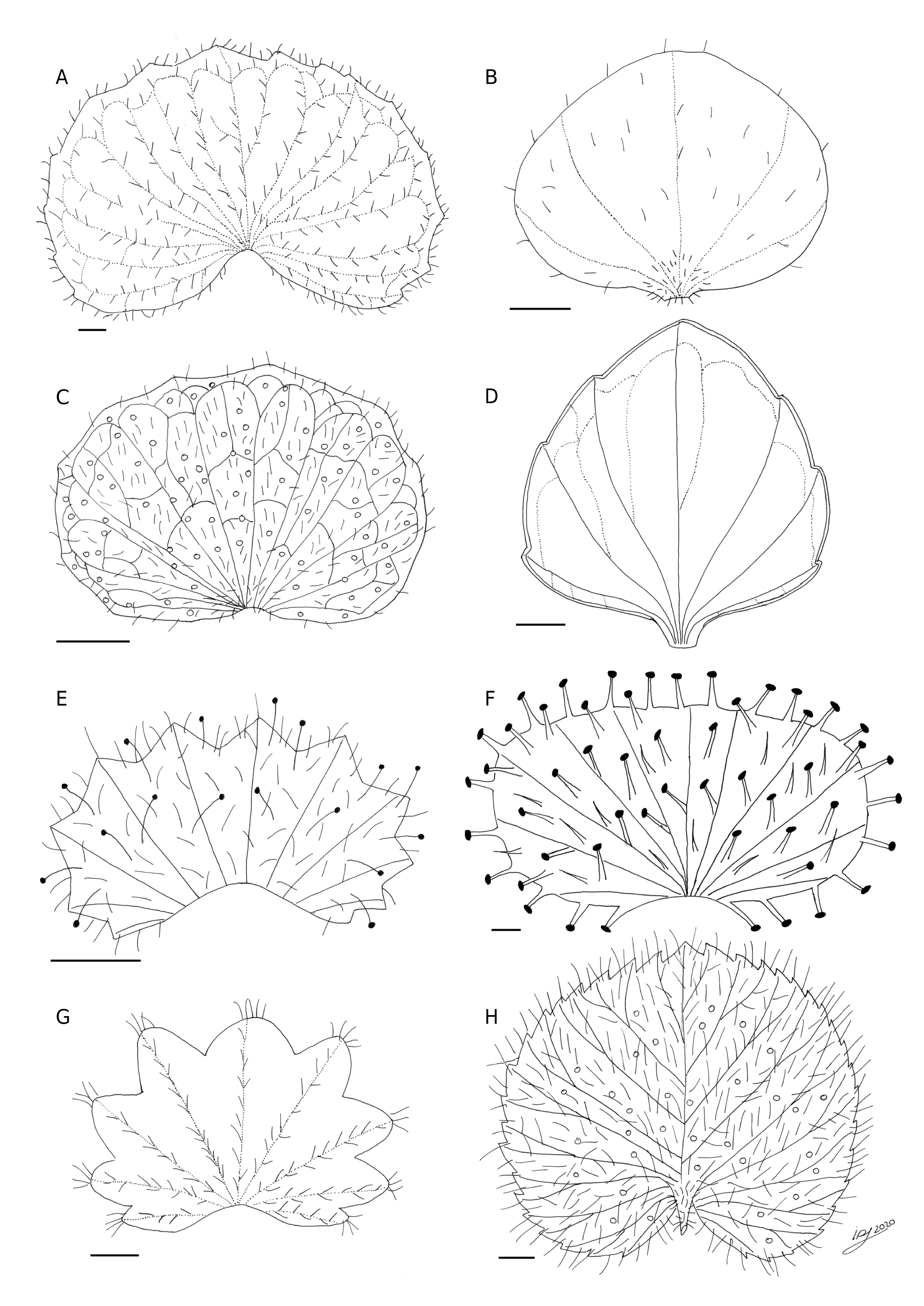
ICONOGRAPHY. — Montero Muñoz et al. (2020a); Fig. 46C. View FIG
ETYMOLOGY. — The epithet refers to type locality, the Isalo massif ( Madagascar), to which this species appears to be endemic.
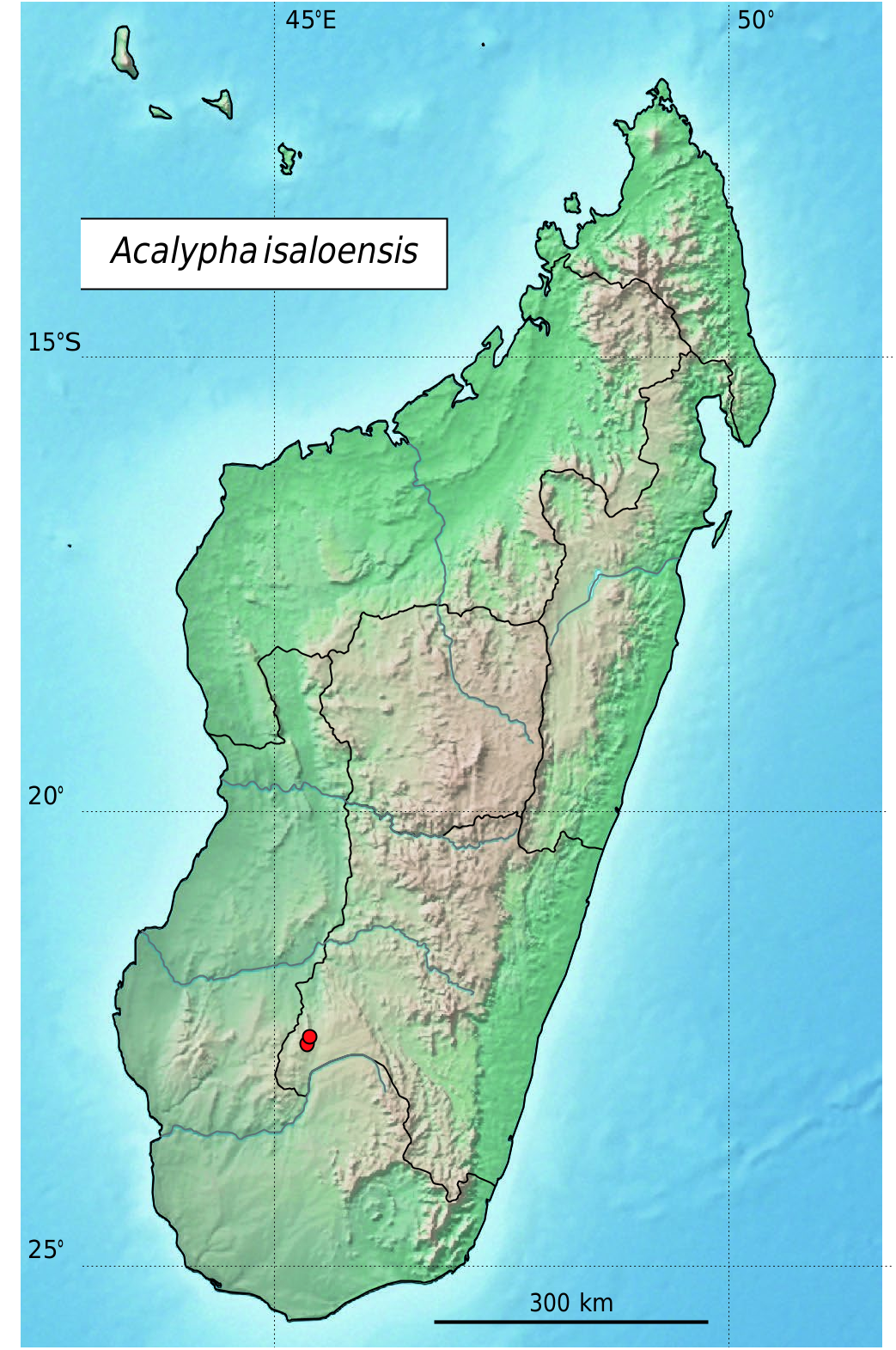
DISTRIBUTION AND HABITAT. — Endemic to Madagascar (Ihorombe).Dry deciduous forest.On sandstone. Altitudinal range 746-900 m ( Fig.40 View FIG ). PRELIMINARY CONSERVATION ASSESSMENT. — The EOO and AOO of A. isaloensis are estimated to be 8 km 2. This species appears to be a narrow endemic known only from the Isalo massif. All collections are from the Isalo National Park, which has been a category II protected area ( Dudley 2008) since 1962. This protected area is threatened by burning to improve grazing, which is a cultural heritage of the Bara people, as well as logging and the impact of introduced species ( Kull 2004; Swierkosz 2007; Andreone et al. 2013). In recognition of its restricted geographic range (a single known location) and the cited threats, A. isaloensis is assigned a preliminary conservation status of Critically Endangered: CR B2ab(i,iii,iv).
MATERIAL EXAMINED. — 3 collections. Madagascar: Jacquemin, H. H278J (P[P04804757, P04804758]); Keraudren-Aymonin, M. 402 (P[P04804755]); Labat, J.-N. 2119 (K, P[P00513133]).
DESCRIPTION
Shrubs or subshrubs, leaf persistence unknown, to 0.8 m tall, monoecious. Branches puberulent with sparse simple, short, trichomes, glabrescent when mature. Axillary buds ovoid, to 1 × 0.7 mm, perulate, perules 2, valvate, membranous, brownish, densely pubescent with simple, short, appressed trichomes. Stipules to 1.2(-2) mm long on young branches, sometimes reduced to 0.5 mm long on older branches, triangular-lanceolate, apex acute, with appressed trichomes, margin with sessile glands. Petioles (2-) 3-4.5 cm long, indumentum similar to that on young branches. Leaf blades (5-)6-10(-11.5) × 2-3.5(-4) cm, elliptic to oblong-lanceolate, membranous; base rounded to subcuneate; apex subacuminate,acumen to 10mm long,rounded, mucronate; margin sparsely serrulate, teeth minute, obtuse, callose-edged; upper surface laxly pubescent with simple, short trichomes; lower surface indumentum similar to that on upper surface but denser; axils of the secondary veins with pocket-shaped domatia; venation prominent on upper surface, pinnate, secondary veins 5-10 per side. Stipels absent. Inflorescences spiciform, male, and solitary female bracts, axillary. Male inflorescences to 8.5 cm long, filiform; peduncle to 7 mm long, rachis clearly visible,both with indumentum similar to that on young branches; flowers glomerate; bracts to 0.3 mm long, ovate, sparsely hairy with simple, short trichomes, and with some sessile glands at base. Solitary female bracts sessile, enlarging in fruit to 3.5 × 5 mm, subreniform, appressed puberulent, with sparse resinous drops, margin crenate to subentire; sterile bracts sometimes present, solitary, similar to the female bracts but longer, to 1 × 1.2 cm, suborbicular; bracteoles absent. Male flowers subsessile; buds to 0.5 mm diameter, puberulent. Female flowers 1 per bract, sessile; sepals 3, to 0.3 mm long, triangular, puberulent; ovary c. 1 mm diameter, 3-lobed, papillose, papillae acute, ending in hyaline trichome to 0.5 mm long, surface hispidulous; styles to 8 mm long, connate at base, sparsely hairy, each divided into 5-6 slender segments. Allomorphic flowers not seen. Capsules to 3 mm diameter, papillose-hispid, papillae acute, ending in hyaline trichome to 0.8 mm long, surface puberulent. Seeds too young to describe.
No known copyright restrictions apply. See Agosti, D., Egloff, W., 2009. Taxonomic information exchange and copyright: the Plazi approach. BMC Research Notes 2009, 2:53 for further explanation.
|
Kingdom |
|
|
Phylum |
|
|
Class |
|
|
Order |
|
|
Family |
|
|
Genus |