
Nausithoe maculata Jarms, 1990
|
publication ID |
https://doi.org/10.11646/zootaxa.5336.1.1 |
|
publication LSID |
lsid:zoobank.org:pub:98F89833-1EBB-41A6-B943-2091F2296D40 |
|
DOI |
https://doi.org/10.5281/zenodo.8268486 |
|
persistent identifier |
https://treatment.plazi.org/id/C908878A-FFAA-E137-FF12-FB03FCB3EF66 |
|
treatment provided by |
Plazi |
|
scientific name |
Nausithoe maculata Jarms, 1990 |
| status |
|
Nausithoe maculata Jarms, 1990 View in CoL View at ENA
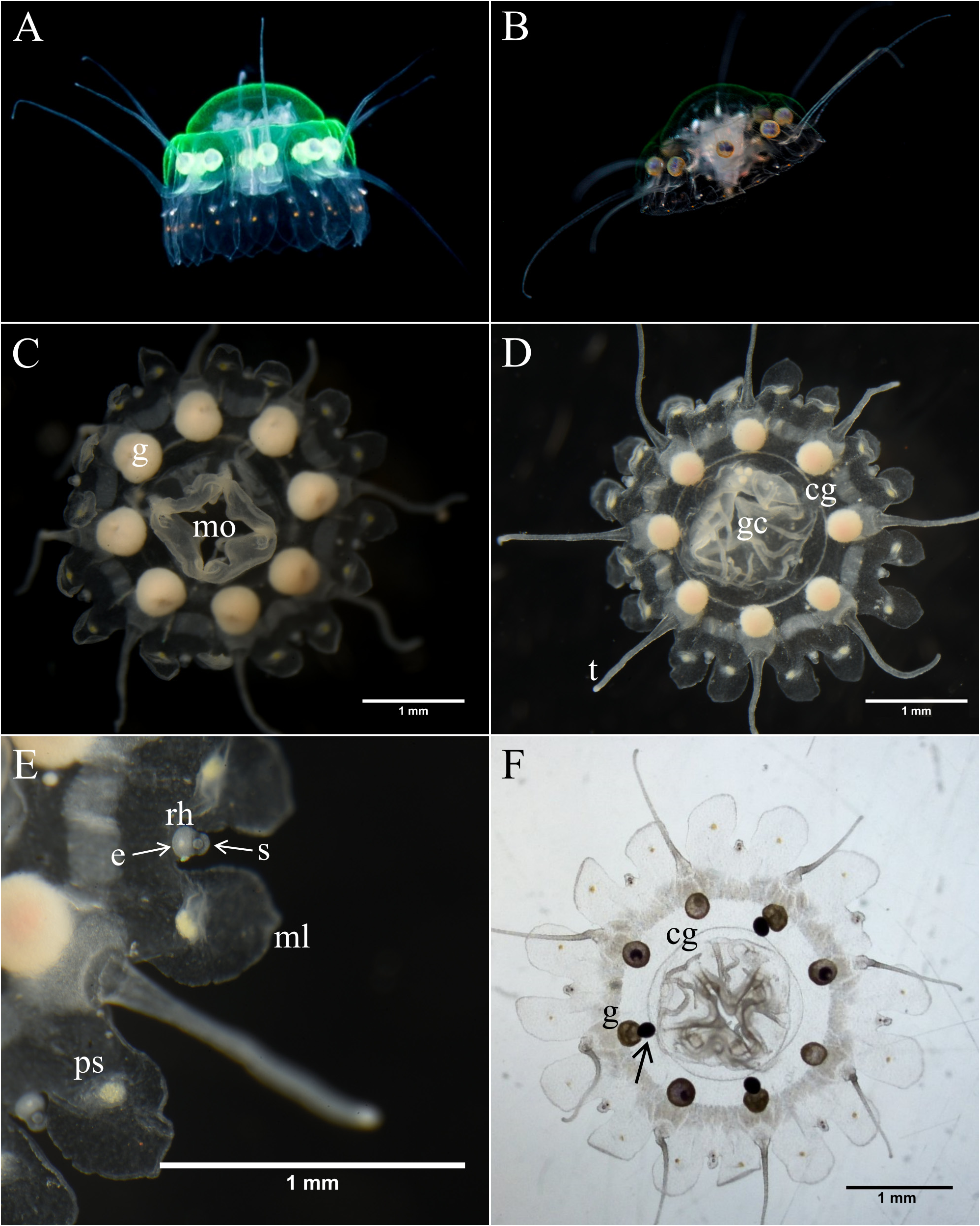
( Fig. 8 View FIGURE 8 )
Nausithoe maculata Jarms, 1990: 21–24 View in CoL , figs 15–17, pl. V.
Nausithoe aurea Silveira & Morandini, 1997: 236–239 View in CoL , figs 1–7, pls I–II.
Holotype ZMH C11534 View Materials .
Material examined: NMNH 57648 View Materials , 57650 View Materials , 57651 View Materials , 57657 View Materials , 57660 View Materials , 57656 View Materials , 57658 View Materials and 57659 (more than 100 specimens from Puerto Rico 1975, no information on depth), NMNH 43306 View Materials ( eight specimens from Dry Tortugas 1929, no information on depth), NMNH 57764 View Materials , 57765 View Materials , 57766 View Materials , 57767 View Materials , 57768 View Materials , 57772 View Materials and 57773 (more than 50 specimens from Belize 1978, no information on depth); 24 medusae from culture (polyps from Cuba 2001 and S„o Sebasti „o, Brazil 2018, shallow waters) and photo from underwater photographers, Linda Ianniello and Suzan Meldonian ( SE Florida, USA 2015–2016, depth: 6–12 m) .
Diagnosis: medusa—hypodome bell with one yellow pigment spot in each lappet; polyp—solitary with 16 cusps per whorl.
Description: Based on original description. Adult medusa 4 mm in diameter, 2 mm of this the central disc; flattened transparent umbrella (hypodome) with a yellow pigment spot in the center of each lappet; rounded lappets with pointed tips; rhopalia with statocyst and red ocellus; 7 gastric filaments per quadrant ( 28 in total); spherical gonads (in life female blue, male brownish). Polyp solitary; living in shallow waters ( 5–10 m); 13 mm total length; 16 cusps per whorl; maximum of 8 whorls of cusps. When describing Nausithoe aurea, Morandini & Silveira (2001a , b) highlighted the production of a planuloid by the polyp, apart from the typical strobilation resulting in ephyrae. This feature has not been observed in polyps from Cuba or Puerto Rico.
Type locality: Puerto Rico (shallow waters).
Distribution: Caribbean, Florida ( USA), Brazil.
Remarks: Examined specimens had from three to seven gastric filaments per quadrant. The gonads were round, varying in color from dark brown to yellowish-white. Specimens had a maximum total diameter of 6 mm and tentacles were about 3 mm long. There is a report of N. aurea from the Cape Verde Islands ( León et al. 2005), but no image is provided and the identity could not be checked.
| ZMH |
Zoologisches Museum Hamburg |
No known copyright restrictions apply. See Agosti, D., Egloff, W., 2009. Taxonomic information exchange and copyright: the Plazi approach. BMC Research Notes 2009, 2:53 for further explanation.
|
Kingdom |
|
|
Phylum |
|
|
Class |
|
|
Order |
|
|
Family |
|
|
Genus |

Nausithoe maculata Jarms, 1990
| Molinari, Clarissa G., Collins, Allen G. & Morandini, André C. 2023 |
Nausithoe aurea
| Silveira, F. L. & Morandini, A. C. 1997: 239 |
Nausithoe maculata
| Jarms, G. 1990: 24 |